Ink Atlas
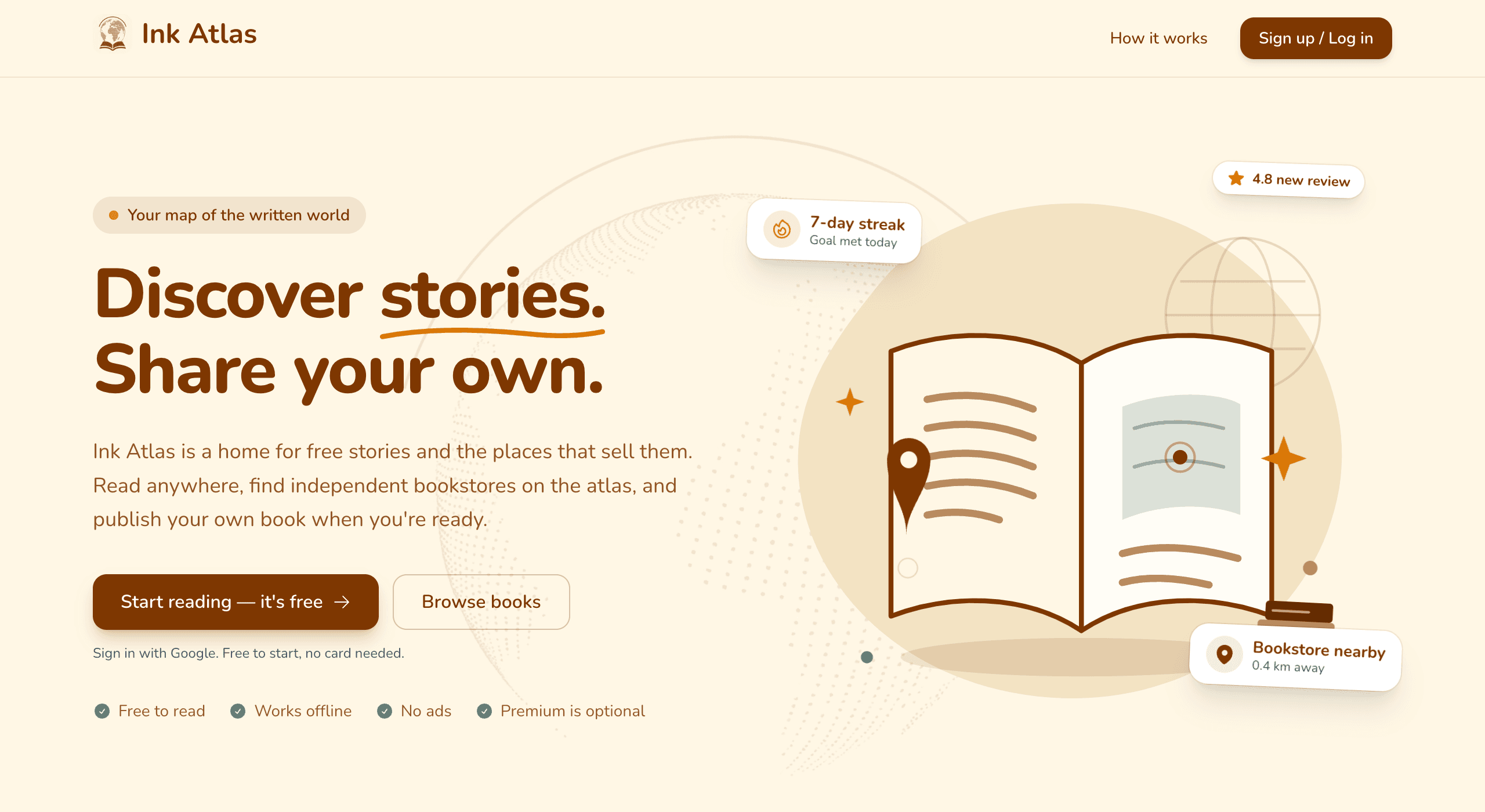
A reading and writing platform I conceived, built and launched independently: a comfortable reader with offline support, an atlas of bookstores, AI-powered reading and writing tools, and payments through two providers.
- Client
- Ink Atlas — my own product
- Role
- Founder and sole engineer
- Timeline
- Solo build, launched November 2026
- Year
- 2026
- 300+
- Books live at launch
- 46
- Automated tests
- 2
- Payment providers
01
The problem
Reading online usually means a handful of separate tools: one to find books, another to look up words, somewhere else to keep notes, and a search engine to work out where to buy a book nearby.
I wanted all of that in one place that was comfortable to read in and free to start, and also gave new writers somewhere to publish and find their first readers.
The hard part was not any single feature. It was running a product that people can sign in to, pay on and trust with their writing, with one person responsible for all of it.
02
My role
I designed and built it alone, from the data model to the launch.
That covered the product and interface, the frontend and backend, authentication, the AI features, payments, moderation, security, SEO and deployment.
03
The engineering
A reader built for comfort
Readers can make the reading experience their own, choosing between paged and scrolling views, adjusting themes, fonts and text size, and switching to a softer night tone. Looking up a word or saving a thought doesn't mean stepping away from the book; the dictionary and notes are right there on the page.
Offline reading that respects privacy
Readers can save a book and keep reading without a connection, and the offline experience is designed with privacy in mind. Gentle web push reminders bring them back to their daily reading goals.
An atlas of independent bookstores
The atlas is an interactive map of independent bookstores, reviewed by moderators and grown through suggestions from readers. A second map turns discovery into a journey, letting readers explore books country by country.
AI with guardrails
Quill, the book guide, uses Claude to recommend from the platform's own catalogue, so every suggestion points to a book readers can actually open. Writers get optional AI help with proofreading, rewrites in their own voice and writing suggestions, and nothing changes in a chapter until the writer says yes.
I selected models for each task based on the balance of quality, speed and cost. Every feature has usage limits, and published books go through an AI-assisted moderation check, with anything flagged sent to a human moderator before readers see it.
Payments that only count once
Two payment providers sit behind a single interface, so the product can switch between them without disrupting payments in flight. Payments are verified directly with the provider, and settlement is idempotent: each successful payment is applied exactly once, with the credit grant protected by a database transaction. Automated tests cover the payment flow.
A writer studio with honest analytics
Writers get a space of their own: a rich-text editor with drafts and version history, flexible ways to publish, and analytics that show where readers begin, finish and drift away, chapter by chapter.
Built for launch
Before launch I treated security, abuse prevention and search visibility as part of the product, not an afterthought. Data access is locked down, writes are rate limited, and public book pages are built so search engines can find them.
04
What I shipped
- A personalised reading experience with offline access, annotations and reading goals.
- Book discovery through bookstore and country-based maps.
- AI-powered reading assistance, writing tools and content moderation.
- A writer studio with publishing workflows and reader analytics.
- Two payment integrations with verified, idempotent settlement.
- Production infrastructure covering authentication, security, notifications and SEO.
05
Results
- Launched in November 2026 on its own domain with over 300 books, from public-domain classics to books by new writers.
- Running in production with sign-in, payments and email in place.
- Covered the riskiest part, payments, with 46 automated tests that run in CI.
06
Stack
- App
- Next.js 15
- React 19
- Node.js
- TypeScript
- Tailwind CSS 4
- Data & auth
- PostgreSQL (Supabase)
- Prisma
- NextAuth (Google)
- AI
- Anthropic Claude
- Maps, editor & offline
- MapLibre GL
- Tiptap
- Service Worker
- Web Push
- Payments & infra
- Paystack
- Bachs
- UploadThing
- Vercel
- GitHub Actions
- Quality
- Node.js Test Runner
- tsx
Next breakdown
Role-based LMS
A learning and career-development platform for teams, combining courses, career ladders, skills assessments and reporting with separate trainee and manager experiences.